27. Busan in 2 Nights, 3 Days — Haeundae, Jagalchi and Gamcheon
Ask a Korean where a foreign friend should go after Seoul, and the answer is Busan before the sentence is finished. It is the country's second city, its biggest port, and the one major destination where the sea is not a view but the whole point. A direct KTX puts it about three hours from Seoul Station, which is why almost everyone folds it into a Seoul trip rather than treating it as a separate one.
Two nights is the natural length. It gives you one full day for the beach side of the city and one full day for the harbor side, with a third morning left over for the single thing you most want to see. This is that plan, built around the three places first-time visitors actually ask about: Haeundae Beach, Jagalchi Market and Gamcheon Culture Village.
Quick Info
- What this is: A 2-night, 3-day Busan itinerary for a first visit — Day 1 Haeundae, Day 2 Jagalchi and Gamcheon, Day 3 your pick
- Getting there: Direct KTX from Seoul Station to Busan Station, about 3 hours. Book at the official Korail site or app
- Haeundae Beach: 264 Haeundaehaebyeon-ro, Haeundae-gu. A 1.5 km sand beach; free. Metro Line 2 Haeundae Station, Exit 5, then about 15 minutes on foot
- Jagalchi Market: 52 Jagalchihaean-ro, Jung-gu. Open 05:00–22:00; closed the first and third Tuesday of the month. Metro Line 1 Jagalchi Station Exit 10 or Nampo Station Exit 2, about 6 minutes on foot
- Gamcheon Culture Village: 203 Gamnae 2-ro, Saha-gu. Free. Visit between 09:00 and 18:00 — the residential alleys are off-limits to tourists outside those hours
- Getting to Gamcheon: Metro Line 1 Toseong Station Exit 6, then village bus Saha 1-1, Seo-gu 2 or Seo-gu 2-2 to Gamjeong Elementary School, 5 minutes on foot
- Getting around: Busan Metro lines 1–4 run roughly 05:00–23:59; T-money and Cashbee transit cards from Seoul work here too
- Best months: The beach season is high summer; the city itself works year-round
In One Line
One day for the beach city, one day for the port city, one morning for whichever Busan you liked more.
Why Busan Works as a Second Stop
Seoul and Busan are the two poles of a Korean trip, and they are genuinely different cities. Seoul is palaces, mountains and neighborhoods; Busan is water. The city wraps around a working harbor and a string of beaches, and its best moments — a fish market at breakfast, a coastal train at noon, a hillside village at sunset — all face the sea.
The logistics are the easy part. The KTX runs direct from Seoul Station to Busan Station all day long, and the transit card you bought in Seoul works on the Busan Metro without any ceremony. If you are coming to Korea for World Youth Day 2027, this is the extension trip nearly every group will be weighing for the days before or after Seoul — and it fits in exactly the two-night window most schedules allow.
Day 1 — Haeundae and the Coast
Take a morning KTX, drop your bags, and give the whole first day to Haeundae. It is the beach the whole country pictures when it says the word: 1.5 kilometers of white sand backed by a wall of high-rises, drawing more than ten million visitors in a season. In July and August it is a carnival of parasols; the rest of the year it is a long, calm walk with the city at your back. From Haeundae Station on Metro Line 2, Exit 5, it is about fifteen minutes on foot to the water.
Walk the sand west and you run into Dongbaekseom, a small forested headland stitched to the beach's end. An easy coastal trail loops it through the trees, with open views back across the water toward the towers of Marine City. It is the best free hour in the neighborhood.
At the beach's other end, at Mipo, the old coastal rail line has been reborn as Blueline Park. A slow beach train runs the shoreline from Mipo past Cheongsapo to Songjeong, and small elevated Sky Capsules crawl above the same coast at walking pace. The track hugs the sea the entire way, and there is a walking trail along the line if you would rather earn the view. Fares and timetables are on the official Blueline Park site; the ride is popular enough that weekend visitors should not leave it for the last hour of the day.
Stay near the beach for the evening. The Haeundae Traditional Market, a block inland, is the cheap and loud dinner option; the terraces near Dongbaekseom are the expensive and glittering one.
Day 2 — Jagalchi, Nampo-dong and Gamcheon
Day 2 is the old city, and it starts early, because Jagalchi Market does. One of the largest seafood markets in Korea opens at five in the morning on the Nampo waterfront, and the earlier you arrive the more of the real market you see. This is where a huge share of the fish eaten in Korea passes through, and most of the people selling it are the famous Jagalchi ajumeoni — the market women who have run these stalls for generations, since the market took its modern form in the years after the Korean War.
The way to eat here is the market's own system: pick your fish live on the ground floor, and have it prepared on the spot — the upstairs restaurants will slice it as hoe (Korean-style raw fish), grill it, or drop it into a spicy stew while you watch the harbor. It is about six minutes on foot from Jagalchi Station Exit 10 or Nampo Station Exit 2 on Metro Line 1. One warning that matters: the market rests on the first and third Tuesday of the month, so if your Day 2 lands on a Tuesday, check before you build the morning around it.
The blocks behind the market are Nampo-dong, and they deserve the middle of your day. Gukje Market grew out of the goods that flooded into wartime Busan when the city was the country's refugee capital, and it still sells a little of everything under its arcades. A few alleys over, BIFF Square marks the birthplace of the Busan International Film Festival, which started here in 1996 — and holds the stalls selling ssiat hotteok, the seed-stuffed sugar pancake that is Busan's signature street food. One is enough. You will order two.
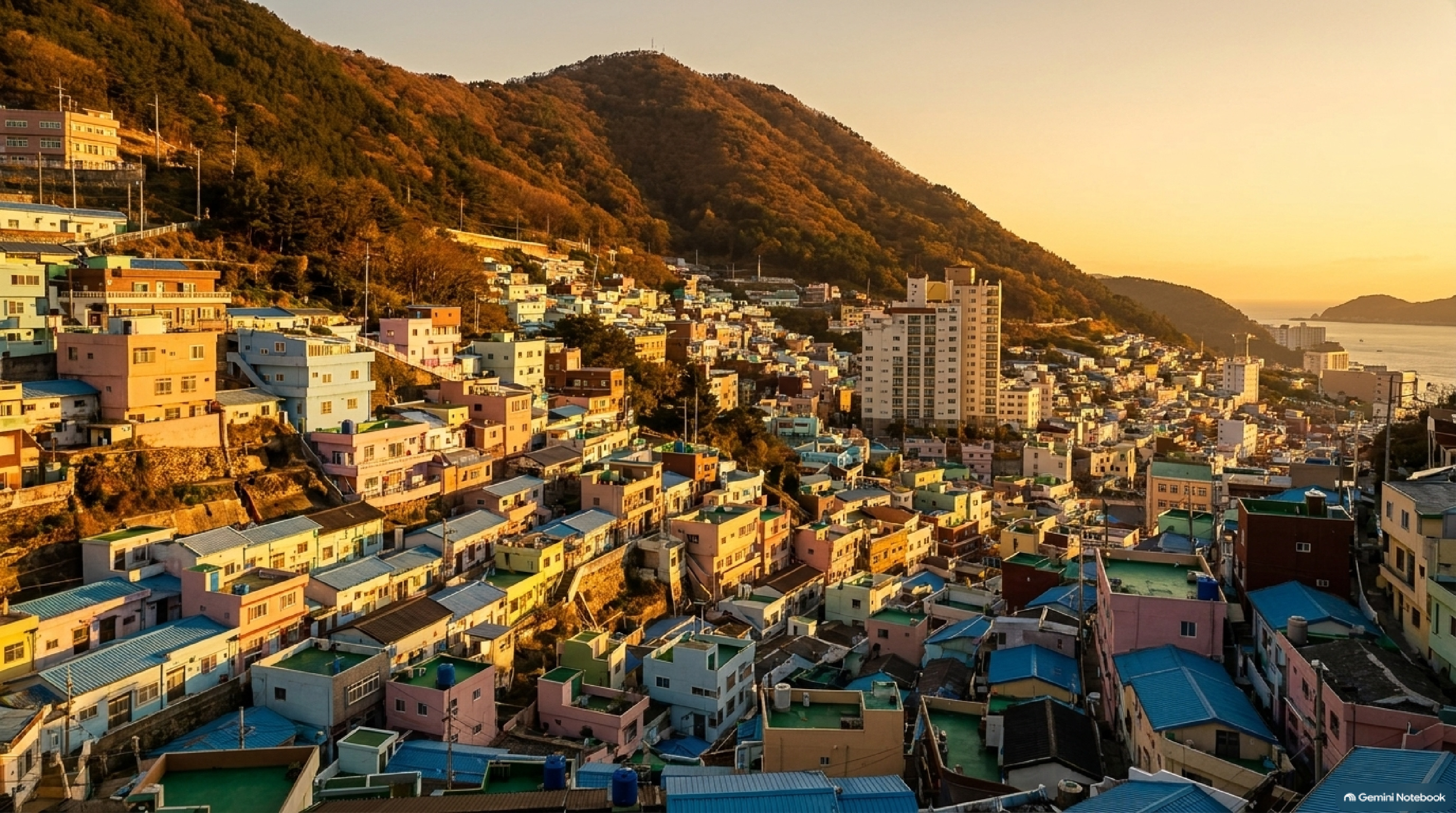
Save Gamcheon Culture Village for the afternoon light. From Toseong Station — one stop from Jagalchi on Line 1 — take Exit 6 and ride village bus Saha 1-1, Seo-gu 2 or Seo-gu 2-2 up the hill to Gamjeong Elementary School; the village entrance is five minutes on foot. What you find is a hillside of small houses stacked in terraces, painted in blocks of color, laced with mural-covered alleys. The village was built by Korean War refugees who cut their homes into the mountainside, and in 2009 residents and artists began turning it into the open-air gallery it is now. Entry is free, and the stamp-tour map sold at the entrance is the rare tourist gimmick that actually improves the visit — it walks you through alleys you would not otherwise find.
Remember what Gamcheon is: a neighborhood people live in. Tourist access to the residential alleys runs from 09:00 to 18:00, and the village asks visitors to keep voices down and keep cameras out of doorways and windows. Plan to leave as the light goes — the view of the stacked houses from the upper road in late afternoon is the photograph you came for anyway.
Day 3 — Pick Your Busan
Check out, stash your bags in a locker at Busan Station, and spend the morning on whichever side of the city won you over.
If it was the coast: Haedong Yonggungsa, in Gijang past Haeundae, is that rarity among Korean temples — built not on a mountain but on the rocks above the sea. You enter through the Iljumun gate and descend 108 stairs through a pine grove to a temple that looks straight onto open water. From Osiria Station on the Donghae Line, Bus 139 runs to the temple. Go early; it is no secret.
If it was the city: stay on the harbor side and walk above the water instead. Busan keeps two glass-floored walkways over the sea — the Songdo Cloud Walk on the city's first beach, and the Oryukdo Skywalk on the cliffs where the coastline turns — and Gwangalli Beach, facing the lit span of the Gwangan Bridge, is the classic last-night view if you would rather trade the morning walk for a late evening one on Day 2.
Then it is the KTX home — Busan Station is on Metro Line 1, so the return is simple from anywhere in the old city.
Getting There and Around
The KTX runs direct from Seoul Station to Busan Station, with departures throughout the day; the Korea Tourism Organization's own guidance is to plan on about three hours for the run. Buy tickets at the official Korail site or the KORAIL app — seats can be booked from a month out, and holiday weekends genuinely sell out. If you are riding on a KORAIL PASS, the Seoul–Busan line is exactly the trip the pass is priced for.
Inside the city, the Busan Metro's four lines plus the Donghae Line cover every stop in this article, running roughly 05:00 to midnight. The T-money or Cashbee card from your Seoul pocket works here, with transfer discounts. Taxis are plentiful and worth it for the Gamcheon hill if the village-bus transfer feels like one step too many.
For the wider system — how the cards, lines and intercity trains fit together — our Korean public transport guide covers the whole country's network.
What to Eat
Busan's food identity is the sea plus the market. From the sea: hoe at Jagalchi, eaten upstairs meters from where it was swimming, and grilled fish everywhere. From the markets: gukbap, the hot rice soup the cheap eateries around Haeundae Traditional Market are known for, and the street food of Gukje and BIFF Square, where ssiat hotteok ends every list. None of this requires a reservation or a phrasebook; pointing works in all of it.
Practical Tips
Sleep near a Line 2 beach or a Line 1 station. Haeundae puts the beach outside your door; Nampo-dong puts Day 2 outside it and the station five minutes away. Either works — pick the day you want to start slowly.
Watch the Tuesdays. Jagalchi's rest days are the first and third Tuesday of the month. It is the one piece of this plan that can actually be closed.
Gamcheon is not an evening stop. The residential alleys close to tourists at 18:00, and the village is a real neighborhood before it is an attraction. Afternoon in, sunset view, out.
Summer changes Haeundae. The swimming season brings crowds in the millions and a sand-sculpture festival in early summer; every other season trades the swimming for space. Neither version is wrong, but they are different trips.
The Bottom Line
Busan is the easiest big decision in Korean travel: one direct train, two nights, and the country's whole second personality. Give the first day to Haeundae and the coast, the second to Jagalchi's dawn and Gamcheon's afternoon, and keep the third morning loose for a sea temple or a glass walkway over the water.
Seoul shows you what Korea built. Busan shows you what it survived, and where it goes on vacation. See both.
Sources
- Busan Tourism Organization, Haeundae Beach — the 1.5 km beach, address, Metro Line 2 Haeundae Station Exit 5 access, Dongbaekseom coastal trail, Haeundae Traditional Market and the early-summer sand festival
- Busan Tourism Organization, Haeundae Blueline Park — the beach train route from Mipo past Cheongsapo to Songjeong, the Sky Capsule, the walking trail along the line, and access from Jung-dong Station
- Busan Tourism Organization, Jagalchi Market — address, 05:00–22:00 hours, Tuesday rest days, six-minute walk from Jagalchi Station Exit 10 or Nampo Station Exit 2, and the raw fish, grilled fish and stew dining
- Korea Tourism Organization, Jagalchi Market — its standing as one of Korea's largest seafood markets, the post-Korean War history, the Jagalchi ajumeoni, and the pick-downstairs-eat-upstairs system
- Korea Tourism Organization, Gamcheon Culture Village — address, free admission, and the village's origin as housing built by Korean War refugees on the mountainside
- Korea Tourism Organization, Gamcheon visitor etiquette — the 09:00–18:00 limit on entering residential areas, and the requests to keep quiet and not photograph homes
- Busan Tourism Organization, Gamcheon Culture Village — directions via Toseong Station Exit 6 and village buses Saha 1-1, Seo-gu 2 and Seo-gu 2-2 to Gamjeong Elementary School, and the 2009 Village Art Project
- Korea Tourism Organization, Busan city guide — the direct KTX from Seoul Station to Busan Station at about 3 hours, plus Gwangalli Beach, the Songdo Cloud Walk and the Oryukdo Skywalk
- Busan Tourism Organization, Haedong Yonggungsa Temple — the seaside cliff setting, the Iljumun gate and 108 stairs, and access from Osiria Station by Bus 139
- Busan Tourism Organization, Gukje Market — the market's formation from goods gathered in wartime refugee-capital Busan
- Busan Tourism Organization, food tour guide — ssiat hotteok at BIFF Square as Nampo-dong's signature street food
- Busan Tourism Organization, trip preparation guide — Busan Metro lines 1–4 and the Donghae Line, 05:00–23:59 operating hours, and T-money and Cashbee card acceptance with transfer discounts
- Korail, official English site — where KTX timetables, fares and seat reservations for Seoul–Busan are checked and booked