21. Getting Around Korea — Subway, Bus, KTX and the T-money Card
Korea is one of the easiest countries in the world to travel without a car. Trains are frequent, buses are everywhere, everything is clean, and almost all of it runs on a single plastic card you can buy at a convenience store in under a minute.
The catch is that nobody explains the small rules — the ones locals absorbed as children and never think about again. Tap out even on the bus. Transfer within thirty minutes. Do not trust the map app you use at home. This guide covers the whole system as a visitor actually meets it, from the airport train to the last bus of the night.
Quick Info
- Transit card: T-money, sold at convenience stores and station machines, roughly 3,000 to 5,000 won for the card itself
- Seoul subway base fare: 1,550 won with a transit card
- Seoul city bus: 1,500 won (blue and green), 3,000 won (red wide-area), 1,400 won (yellow circulation)
- Free transfers: within 30 minutes of tapping out, up to 5 consecutive transfers (60 minutes between 21:00 and 07:00)
- Seoul Climate Card short passes: 1 day 5,000 won, 2 days 8,000, 3 days 10,000, 5 days 15,000, 7 days 20,000, plus 3,000 won for the physical card
- Airport train (AREX Express): Incheon Airport to Seoul Station in about 43 minutes, 13,000 won
- KTX Seoul to Busan: about 2 hours 35 minutes, 59,800 won standard
- Taxi: Seoul base fare 4,800 won, with night surcharges from 22:00
- Map apps: Naver Map or KakaoMap, not Google Maps
In One Line
Buy a T-money card, tap in and tap out every single time, and Korea opens up for the price of a coffee a day.
Why This Matters More Than You Think
Visitors who rent cars in Korea usually regret it. City parking is scarce and expensive, expressway signage assumes Korean reading speed, and the country is small enough that the train beats the car on almost every intercity route. Seoul to Busan — the length of the country — is two and a half hours by high-speed rail.
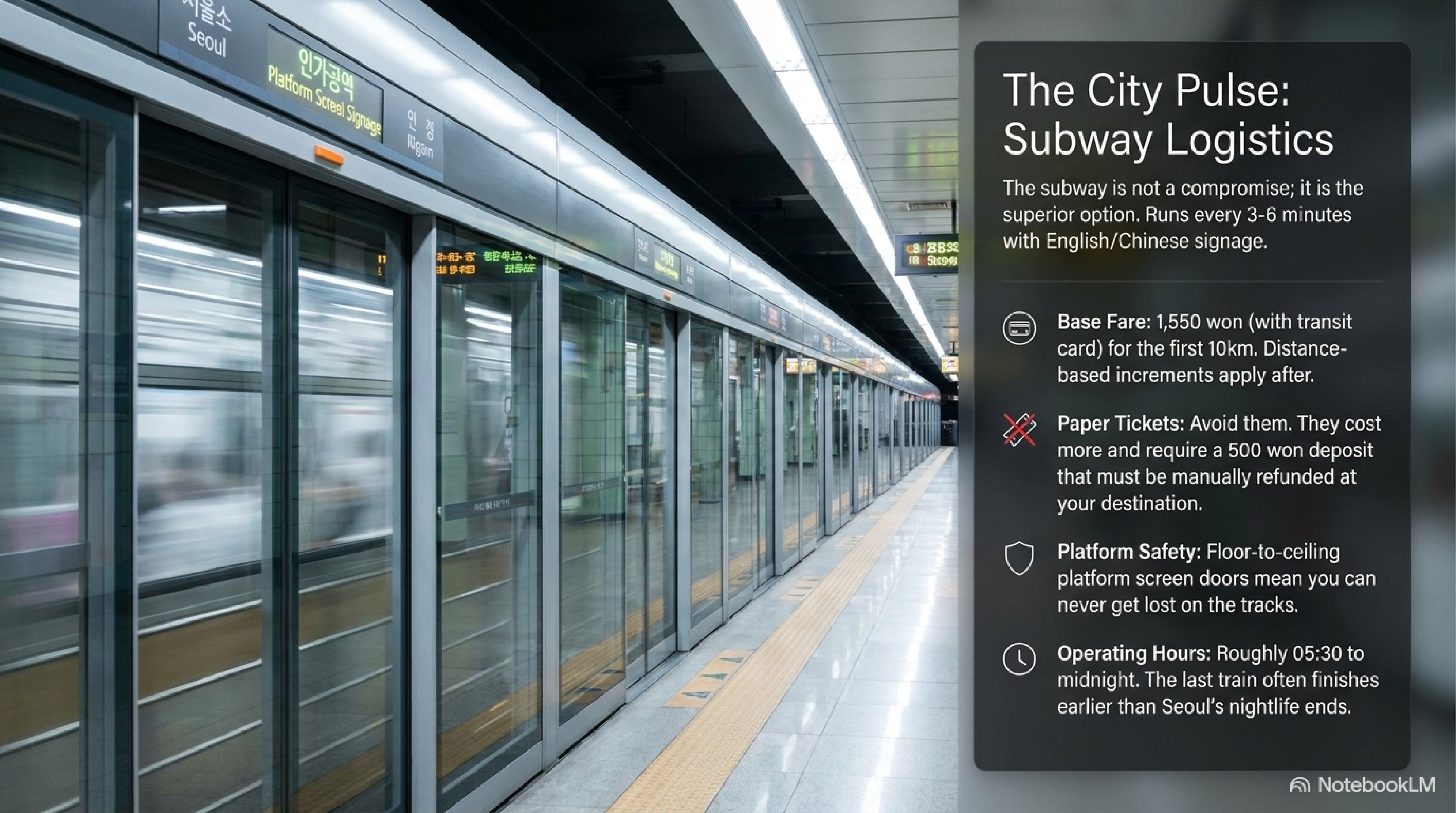
Meanwhile the subway reaches nearly everywhere a visitor wants to go, runs about every three to six minutes in the city, and is signposted in English and Chinese as well as Korean. Station announcements are made in English. Platform screen doors mean you cannot get lost on the wrong side of the tracks. For a first-time visitor, the transit system is not a compromise. It is the better option.
The Card: T-money and Its Cousins
T-money is a stored-value card that works on subways, city buses, most intercity buses, taxis, and even at convenience store counters. You can buy one at any CU, GS25, 7-Eleven or Emart24, and at vending machines inside subway stations. The card itself costs a few thousand won and is not refundable; the balance you load onto it is.
- Loading it: cash at any convenience store counter (just hand over the card and the money), or at station machines. Many machines are cash only, so keep some notes.
- Refunds: remaining balance can be refunded at convenience stores for a small fee. Do it before you fly home; the card itself makes a decent souvenir.
- Cashbee is a competing card that works almost identically. Either is fine.
- WOWPASS is a foreigner-oriented card that combines currency exchange with a built-in T-money function, useful if you are arriving with cash to change anyway.
- Foreign credit cards: since 2026, ticket machines at more than 220 subway stations accept international cards, and Seoul's short-term passes can be bought with them. Still, a transit card is faster at the gate and gets you transfer discounts.
The Rule Everyone Breaks: Tap Out
On the subway you obviously tap at both ends, because there are gates. On buses there are no gates, and this is where visitors lose money.
Korean fares are distance-based and the system links your journeys together. If you tap in on a bus and walk off without tapping the reader by the rear door, the system does not know where you got off. You lose the transfer discount on your next ride, and on some routes you are charged the maximum distance fare. The reader beeps differently for a transfer, and the whole thing takes half a second.
The transfer rule itself is generous: board your next vehicle within 30 minutes of tapping out and you pay no new base fare, only the distance difference. Up to five consecutive transfers count. Between 21:00 and 07:00 the window stretches to 60 minutes. Subway to bus, bus to bus, bus to subway — all of it counts, as long as you tapped.
Subway and Bus in Practice
Seoul's subway base fare is 1,550 won with a card, covering the first 10 kilometres, with small increments after that. A single-journey paper ticket costs more and requires a 500 won deposit you get back from a machine at your destination — another reason to just buy the card. Trains run roughly from 05:30 to midnight; the last train is earlier than nightlife suggests, which is why the city runs late-night N buses.
Buses are colour-coded, and the colour tells you the fare and the range:
- Blue: main trunk routes across the city, 1,500 won.
- Green: shorter feeder routes connecting neighbourhoods to subway stations, 1,500 won.
- Yellow: short circulation loops within a district, 1,400 won.
- Red: wide-area express buses to satellite cities, 3,000 won.
Outside Seoul the colours and fares differ by city, but the card and the transfer principle work the same way nationwide.
Seoul's Climate Card: Worth It or Not
Seoul sells an unlimited pass called the Climate Card, and since 2024 there are short-term versions aimed at visitors: 5,000 won for one day, 8,000 for two, 10,000 for three, 15,000 for five, and 20,000 for seven. The physical card costs 3,000 won on top. Note that the Climate Card is scheduled to be integrated into a different card in 2026, so it is worth checking the current situation at the time of your visit.
The arithmetic is simple. The one-day pass pays for itself at about four rides, which is an ordinary day of sightseeing. But read the boundaries before you buy:
- Covered: subway inside Seoul plus some adjacent Gyeonggi sections, and buses licensed by the City of Seoul, including village buses and late-night buses.
- Not covered: the Shinbundang Line, GTX, subway stations outside the Seoul zone, wide-area and airport buses, and buses licensed by other cities.
- The trap: if you board inside the zone and try to exit outside it, the card will not let you through. You settle up at the station office.
- Short-term passes start the day you charge them; you cannot buy one now for next week.
If your days are Seoul-only, buy it. If you are day-tripping to Suwon, the DMZ or Incheon, a plain T-money card is simpler.
Getting There: From the Airport
From Incheon International Airport, the Airport Railroad has two services on the same tracks. The Express train runs non-stop to Seoul Station in about 43 minutes from Terminal 1, 51 from Terminal 2, for 13,000 won, with cheaper fares booked online. The all-stop commuter train takes around an hour and costs up to about 5,350 won depending on your destination, and it accepts T-money like any other subway line.
Note that the Climate Card does not cover the Incheon airport stretch. Airport limousine buses are the third option: more expensive than the train, but they stop at major hotels and you keep your luggage beside you.
Between Cities: KTX and the Bus
KTX high-speed trains link Seoul to most of the country. Seoul to Busan is about 2 hours 35 minutes for 59,800 won in standard class; Seoul to Jeonju, Gyeongju, Mokpo and Gangneung are all comfortable half-day-or-less journeys. Book through the Korail app or the English site at letskorail.com. Reserved seats sell out on Friday evenings and around holidays, so book ahead if your dates are fixed.
Express buses are the underrated alternative. They are cheaper, they leave every fifteen or twenty minutes from major terminals, and the premium buses have three seats per row that recline nearly flat. For routes the KTX does not serve directly, the bus is often faster door to door.
Practical Tips
- Do not rely on Google Maps. Korean law restricts the export of detailed mapping data, so driving directions are unavailable and transit results are patchy. Install Naver Map or KakaoMap; both have English interfaces and give exit numbers, car positions and real-time bus arrivals.
- Note the subway exit number. Large stations have more than a dozen exits spread over several blocks. Korean directions are always given as "Exit 4", never as street names.
- Stand right on escalators and let people pass on the left.
- The seats at the ends of subway cars are reserved for elderly, pregnant and disabled passengers. They stay empty even in a crush, and sitting in them will earn you a lecture.
- Taxis start at 4,800 won in Seoul with surcharges after 22:00. Kakao T is the standard hailing app, though it may require a Korean phone number; hailing on the street works fine, and international cards are widely accepted in the meter terminal.
- Luggage: subway stations are not uniformly step-free, and transfer corridors can be long. If you are moving between cities with big suitcases, consider a luggage delivery service from your hotel or the airport.
- Keep about 10,000 won on the card at all times. Running out at a gate during rush hour is the one genuinely stressful thing that can happen on Korean transit.
A Note for Pilgrims and Groups
With large Catholic gatherings coming to Korea in 2027, many first-time visitors will arrive in groups. Transit cards are worth buying individually rather than sharing: a card can only be tapped once per vehicle, so a group passing one card around will be stopped at the gate. Group leaders should also know that Seoul's short-term passes are personal, non-transferable, and start on the day of purchase.
The Bottom Line
Korean public transport asks very little of a visitor: buy a card, tap twice per ride, and use the right map app. In return it gives you a country where you can eat breakfast in Seoul, pray at a shrine in the countryside, and be back in the city for dinner without ever holding a steering wheel.
Spend the first ten minutes after landing buying a T-money card. Everything else in this guide follows from that.