18. Father Choi Yang-up's New Official Portrait — A Forensic Scientist, an Anatomist, and a Painter Reconstruct Korea's Second Priest
For more than 160 years, the face of Father Thomas Choi Yang-up — the priest who walked 2,800 kilometers a year through persecution-era Korea — existed only in imagination. He died at 40 in a remote mountain seminary in 1861. No daguerreotype was taken. No sketch survives. Every depiction painted, printed, or carved since then has been a guess.
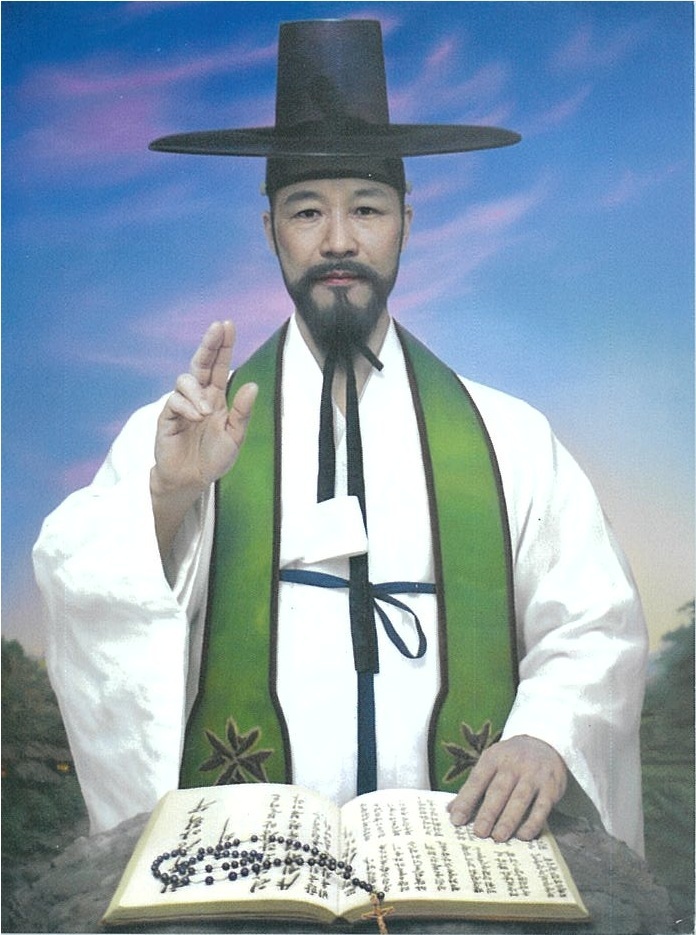
On April 15, 2026, that changed. At Baeron Holy Site, on the 177th anniversary of Choi's ordination to the priesthood in Shanghai, the Diocese of Wonju dedicated the first official standard portrait of Korea's second Catholic priest. The painting was the result of six months of work by a hyperrealist oil painter — backed by a team that included Catholic University anatomists, an applied anatomy research institute, and Korea's National Forensic Service.
It is, as far as we can tell, the first time forensic facial reconstruction techniques have been used to produce an official portrait of a Korean Catholic figure on the road to beatification.
Quick Info
- Event: Dedication of the Official Standard Portrait of Venerable Father Thomas Choi Yang-up
- Date: April 15, 2026 (the 177th anniversary of Father Choi's priestly ordination)
- Location: Father Choi Yang-up Memorial Cathedral, Baeron Holy Site, Jecheon-si, Chungcheongbuk-do
- Painter: Kim Se-jung (Vincent), adjunct professor, College of Fine Arts, Hongik University
- Medium and size: Oil on canvas, 97 cm × 130.6 cm
- Time to paint: ~6 months (including preparation)
- Scientific partners: Department of Anatomy at the Catholic University of Korea, the Applied Anatomy Research Institute, and the National Forensic Service (NFS)
- Connection: Part of Wonju Diocese's ongoing campaign for Father Choi's beatification
Why a New Portrait Now
The Korean Catholic Church has been preparing for two converging milestones. The first is World Youth Day 2027 Seoul, August 3–8, when more than a million young Catholics from over a hundred countries will descend on the capital. The second is Father Choi's beatification, which advanced a major step earlier this year: in March 2026, the Vatican's medical advisory panel confirmed that a miraculous healing attributed to his intercession was scientifically inexplicable.
Many in the Korean Church now hope that the beatification ceremony might take place in time to coincide with WYD 2027 — turning the global gathering into the largest celebration of a Korean blessed in history. If that happens, the Church will need an authoritative, agreed-upon image of him. The new portrait at Baeron is meant to fill that gap.
The painting was commissioned and dedicated under the auspices of the Wonju Diocese, whose territory contains Baeron — the site where Father Choi died in 1861 and where Korea's first Catholic seminary (St. Joseph's) once stood. Bishop Cho Kyu-man of Wonju presided over the unveiling. Father Baek In-hyeon, the rector of Baeron, and Father Shin Woo-sik, who has led the parish's pastoral work in recent years, were both present.
How the Portrait Was Made — Forensics, Anatomy, and Six Months of Oil Paint
The painter is Kim Se-jung, baptismal name Vincent, an adjunct professor in the College of Fine Arts at Hongik University. He is known for hyperrealist oil painting — the kind of work where, from a few meters away, the canvas reads as a photograph. The diocese chose him specifically for that style. The intent was not artistic interpretation but reconstruction.
To give Kim something to paint, the diocese assembled an unusual team:
- The Department of Anatomy at the Catholic University of Korea, which has decades of experience in human craniofacial study
- The Applied Anatomy Research Institute, a specialist body that has worked on historical and forensic reconstructions
- The National Forensic Service (NFS) — the same Korean government agency whose facial reconstruction techniques are used to identify unidentified remains and to assist in criminal investigations
Working from 3D CT scan data — the diocese has not publicly detailed exactly whose anatomical references were used, but the process produced what is described as a "face and full-body database" for Father Choi — the team built a reconstruction that the diocese believes brings the image as close as currently possible to the priest's actual appearance.
From that database, Kim spent roughly six months at the canvas. The final painting measures 97 cm wide and 130.6 cm tall — close to life-size for the figure depicted — in oil on canvas.
What's in the Painting
The composition is densely layered. Father Choi stands in priestly vesture but with one strikingly Korean detail: he wears a gat — the traditional black horsehair hat of the late Joseon dynasty — over his head. This is historically accurate. Catholic missionaries and Korean priests of the persecution era often disguised themselves in ordinary Korean dress while traveling between hidden Christian villages, and Father Choi's letters describe him doing exactly this.
Around his neck, he wears a green stole — the liturgical vestment of a priest in Ordinary Time. Korean Catholics of the 19th century would have understood the visual code instantly: a man who is both a Joseon scholar and a Catholic priest, holding the two worlds together on his body.
Several other elements anchor the portrait to Father Choi's biography:
- The Cheonju gasa — Catholic hymns in vernacular Korean verse, which Father Choi himself helped compose and distribute to teach catechism in villages where most people could not read Chinese
- A rosary, hung at his side
- Baeron Holy Site, the place of his death, suggested in the background
- St. Joseph's Seminary, the school he helped found at Baeron in 1855 — the first Catholic seminary on Korean soil
The painting is, in effect, a single image carrying his entire ministry: priest, pastor, scholar, hymn writer, founder of Korean Catholic education, and pilgrim of the mountains.
What an "Official Standard Portrait" Means in Korea
The term used in Korean — "표준영정" (pyojun yeongjeong), literally "standard official portrait" — carries weight in Korean cultural tradition. The phrase has historically been reserved for government-designated portraits of major Korean historical figures: King Sejong on the 10,000-won note, Admiral Yi Sun-sin in textbooks. These are the images Koreans grow up with, the visual shorthand for figures who shaped the country.
By using that language, the Wonju Diocese is making a deliberate claim: this is the portrait the Korean Church wants used in chapels, schools, prayer cards, pilgrimage signage, and parish art. Not as one option among many, but as the image of Father Choi going forward.
Older depictions of Father Choi — sketches and stained-glass images created in earlier decades — remain meaningful, especially in places that have used them for generations. But future pilgrimage materials, beatification iconography, and likely most new sacred art at Korean shrines will follow this portrait's likeness.
Seeing the Portrait Yourself
The original hangs at the Father Choi Yang-up Memorial Cathedral at Baeron Holy Site, in the mountains east of Jecheon, Chungcheongbuk-do. Baeron is open to the public year-round during daylight hours, free of charge.
Address and Access
- Address: Baeron-gil, Bongyang-eup, Jecheon-si, Chungcheongbuk-do
- Hours: Daily, daylight hours (the Memorial Cathedral has separate liturgical hours; check ahead if you want to see the portrait inside during a quiet moment)
- Admission: Free
- Recommended time on site: 1–2 hours for the cathedral and tomb area, longer if you walk the forest paths
From Seoul
- By car: ~2.5 hours via the Jungang Expressway. Free parking on site.
- By bus: Seoul → Jecheon Bus Terminal (~2 hours, express bus from Dong Seoul Terminal), then local bus or taxi to Baeron (~40 minutes by bus, ~20 minutes by taxi).
Combining with Other Sites
Baeron pairs naturally with Baeti Holy Site in Jincheon — Father Choi's pastoral territory and the site of a museum dedicated to his life. Both are in Chungcheongbuk-do, about 90 minutes apart by car, and both are walkable in a single day if you start early. The two sites together give a complete picture: where he lived and worked (Baeti), and where he died (Baeron).
If you are visiting from overseas and have already booked into WYD 2027, build a day trip to Baeron into your itinerary before or after the main Seoul program. Direct trains and buses make this realistic for most schedules.
Practical Tips for Pilgrims
- Quiet, contemplative atmosphere. Baeron is an active place of prayer. The Memorial Cathedral where the portrait hangs is used for daily mass and pilgrim retreats. Keep voices low, dress respectfully (covered shoulders, modest clothing).
- Bring water and light snacks. Baeron is rural — food options near the entrance are limited. Jecheon city, 30 minutes away, has full services.
- Photography of the portrait. Personal photos are generally permitted inside the cathedral when no liturgy is in progress. Use no flash. If a mass or service is happening, simply wait.
- Combine with the surrounding pilgrimage trail. The forest paths around Baeron include Father Choi's tomb and the ruins of St. Joseph's Seminary. Plan an extra hour to walk them.
- Best season: April through early November. Winter access is possible but cold, and forest paths can be icy in January and February.
- Language: English signage at Baeron is limited. Download Naver Map and a translation app before you go. The Memorial Cathedral often has multilingual pilgrim materials available on request from the office.
The Bottom Line
A new portrait of a 19th-century priest may not look, from outside the Korean Church, like the most consequential headline of 2026. But for the community preparing to welcome a million pilgrims to Seoul in fifteen months — and possibly to celebrate a beatification at the same time — it matters.
For most of Korean Catholic history, Father Choi has been the priest without a face. He left behind 19 letters in Latin, the catechism hymns he translated and taught, the seminary he helped found, and the memory of a man who walked himself to death visiting the hidden Christian villages of a country that wanted him dead. What he did not leave behind was an image of himself.
What the diocese unveiled at Baeron on April 15 is, in a sense, a face given back. Built from anatomical research and forensic technique, painted in oil over six months, hung in the cathedral that bears his name — it is the closest the Korean Church can now come to looking at the Martyr of Sweat directly.
And for visitors heading to Korea over the next year, it is one more reason to make the trip out to Baeron. The painting is there, on the wall, waiting.