14. Remembering Pope Francis in Korea — The Five Days That Changed Korean Catholicism
On August 14, 2014, a plane from Rome touched down at Seoul Air Base. Pope Francis stepped onto Korean soil for the first time — his first trip to Asia as pope. Over the next five days, he would beatify 124 Korean martyrs before a million people, close the 6th Asian Youth Day, visit a community for the disabled and abandoned, and celebrate mass for peace and reconciliation on the divided peninsula.
It was only five days. But the places he visited became permanently marked in Korean Catholic memory. More than a decade later, those sites remain some of the most powerful pilgrimage destinations in the country — and with WYD 2027 returning to Seoul, they are about to matter all over again.
He came once. And now, through WYD 2027, the Pope will return. This time it will be Pope Leo XIV, who assumed the papacy in May 2025. But the sites that Francis consecrated with his presence in 2014 will be waiting.
Here is every place Pope Francis visited during those five days — what happened there, what you can see today, and how to get there.
Quick Info
- Visit dates: August 14–18, 2014
- Sites covered: 6 major locations across Seoul and Chungcheong Province
- Cost: All sites are free to visit
- Time needed: 2–3 days to visit all sites (Seoul sites in one day, Chungcheong sites in one or two days)
- English: Good at Seoul sites (Gwanghwamun, Myeongdong, Seosomun); limited at rural sites (Haemi, Solmoe, Kkottongnae)
- Best for: Catholic pilgrims, modern history enthusiasts, WYD 2027 visitors
- Current Pope: Pope Leo XIV (since May 2025)
Day 1 — Gwanghwamun Square: The Beatification of 124 Martyrs
August 16, 2014. The heart of Seoul was transformed. Gwanghwamun Square — the grand plaza in front of the old Joseon palace — became the site of the largest outdoor papal mass ever held in Korea. An estimated one million people filled the square and the surrounding streets.
Pope Francis beatified 124 Korean martyrs — laypeople who had been killed for their Catholic faith during the Joseon-era persecutions of 1791–1888. Among them was Paul Yun Ji-chung, who had destroyed his family's ancestral tablets in obedience to his faith, sparking the first persecution. The beatification brought the total number of Korean blessed and saints to 227 — one of the largest groups of recognized martyrs in any country.
The image of Pope Francis celebrating mass against the backdrop of Gwangjeonmun Gate, with a sea of humanity stretching down Sejong-daero, remains one of the most iconic moments in Korean Catholic history.
Visiting Gwanghwamun Square Today
- Address: 172 Sejong-daero, Jongno-gu, Seoul
- Hours: Open 24 hours (outdoor public space)
- Admission: Free
- Transport: Gwanghwamun Station (Line 5), Exit 2 — you step directly onto the square
- What to see: The square itself, the statue of King Sejong, Gyeongbokgung Palace behind it. There is no permanent papal visit marker, but the square is unmistakable — stand where a million people stood
- Time needed: 30 minutes for the square; add 1–2 hours if visiting Gyeongbokgung Palace
Day 2 — Haemi Martyrs' Shrine: Asian Youth Day Closing Mass
On August 17, Pope Francis traveled to Haemi in South Chungcheong Province to celebrate the closing mass of the 6th Asian Youth Day. An estimated 50,000 young Catholics from across Asia gathered at the Haemi Naepo area, an open field near Haemi Fortress.
Haemi is one of Korea's most significant martyrdom sites. During the 1866 Byeongin Persecution, hundreds of Catholics were executed here — many were buried alive in a well or beaten to death and dumped into a pit. The fortress walls still stand. A towering bronze monument marks the site of the mass grave.
Pope Francis told the young people gathered there: "Do not be afraid to bring the quiet and gentle voice of Christ to every corner of the world."
Visiting Haemi Today
- Address: Haemi Martyrs' Shrine (Haemi Sungyoji), 13 Seongji-gil, Haemi-myeon, Seosan-si, Chungcheongnam-do
- Hours: 9:00–18:00 daily (grounds accessible longer hours)
- Admission: Free
- Transport: From Seoul, take an express bus from Seoul Express Bus Terminal to Seosan Terminal (~2 hours), then local bus or taxi to Haemi (~20 minutes). By car, ~2 hours via Seohaean Expressway
- What to see: Haemi Fortress (the execution site), the martyrs' shrine and memorial, the mass grave marker, the Asian Youth Day mass site, and the pilgrimage museum
- Time needed: 2–3 hours
Day 3 — Solmoe Shrine: Birthplace of Korea's First Priest
On August 15 — the Feast of the Assumption and also Korean Liberation Day — Pope Francis visited Solmoe Shrine in Dangjin, South Chungcheong Province. This is the birthplace of St. Andrew Kim Taegon, Korea's first Catholic priest and the most famous of its 103 canonized saints.
Andrew Kim was born here in 1821 into a devout Catholic family. At age 15, he was sent to study at a seminary in Macau, eventually becoming the first Korean to be ordained a priest. He was arrested and beheaded in 1846 at just 25 years old. He was canonized by Pope John Paul II in 1984.
At Solmoe, Pope Francis celebrated mass before thousands of pilgrims and prayed at the birthplace of this young saint. The shrine sits on a hillside surrounded by pine trees — solmoe means "pine hill" in Korean.
Visiting Solmoe Today
- Address: 132 Solmoe-gil, Sinjeon-dong, Dangjin-si, Chungcheongnam-do
- Hours: 9:00–18:00 daily
- Admission: Free
- Transport: From Seoul, express bus to Dangjin Terminal (~1.5 hours from Nambu Terminal), then taxi (~15 minutes). By car, ~1.5 hours via Seohaean Expressway
- What to see: Andrew Kim Taegon birthplace, the memorial church built for the papal visit, the old pine forest, the pilgrim center, and the outdoor Stations of the Cross
- Time needed: 1.5–2 hours
Solmoe and Haemi are both in South Chungcheong Province, about 40 minutes apart by car. You can visit both in a single day trip from Seoul.
Day 4 — Kkottongnae: The Community of the Forgotten
On August 16, Pope Francis made a deeply personal stop at Kkottongnae — a Catholic community in Eumseong, North Chungcheong Province, dedicated to caring for the disabled, abandoned, and destitute. The name means "flower village."
Founded in 1976 by Father John Oh Woong-jin with a single mentally disabled man he found abandoned on the street, Kkottongnae has grown into a sprawling community that cares for over 3,000 residents. It includes hospices, homes for the elderly and disabled, rehabilitation centers, and a university.
Pope Francis visited the residents, embraced them, and celebrated mass at the community's outdoor altar. His visit here was widely seen as embodying his message that the Church must be "a field hospital" for the wounded and marginalized. He told the community: "Here I see the tenderness of God made visible."
Visiting Kkottongnae Today
- Address: 387 Kkottongnae-gil, Gamgok-myeon, Eumseong-gun, Chungcheongbuk-do
- Hours: Pilgrimage visits generally 9:00–17:00 (call ahead recommended: +82-43-872-3100)
- Admission: Free
- Transport: From Seoul, express bus to Eumseong Terminal (~1.5 hours from Dong Seoul Terminal), then taxi (~20 minutes). By car, ~1.5 hours via Jungbu Expressway
- What to see: The community grounds, the papal mass altar, the Chapel of the Blessed Sacrament, the Way of the Cross trail, the House of Hope museum. Guided pilgrimage programs are available (Korean only; arrange in advance)
- Time needed: 2–3 hours
Day 5 — Myeongdong Cathedral: Mass for Peace and Reconciliation
On August 18, his final day in Korea, Pope Francis celebrated mass for peace and reconciliation at Myeongdong Cathedral, the symbolic heart of Korean Catholicism. The cathedral, built in 1898, is the oldest Catholic parish church in Seoul and the seat of the Archdiocese of Seoul.
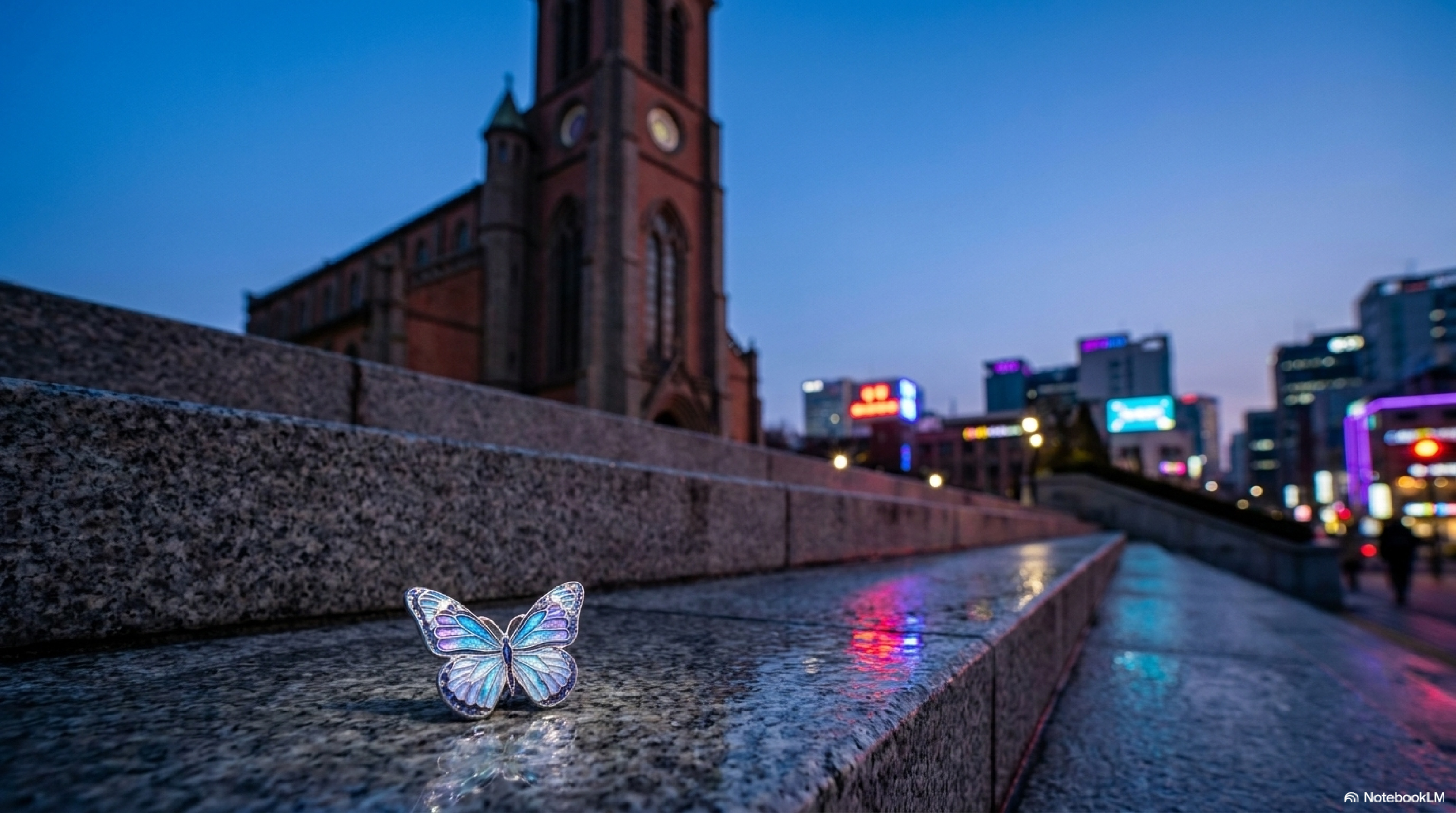
The mass carried special weight on the Korean peninsula. Pope Francis prayed for reconciliation between North and South Korea and for the "comfort women" — Korean women forced into sexual slavery during World War II — several of whom attended the mass wearing butterfly badges. He invited them to stand and be acknowledged by the congregation.
It was a profoundly emotional moment. The cathedral, which had served as a sanctuary for pro-democracy protesters during Korea's military dictatorship in the 1980s, once again became a place where justice and faith met.
Visiting Myeongdong Cathedral Today
- Address: 74 Myeongdong-gil, Jung-gu, Seoul
- Hours: 9:00–21:00 daily (mass schedule varies; check the cathedral website)
- Admission: Free
- Transport: Myeongdong Station (Line 4), Exit 5 — 10-minute walk uphill. Or Euljiro 1-ga Station (Line 2), Exit 6
- What to see: The neo-Gothic cathedral (the building itself is beautiful), the underground crypt chapel, the statue of the three patron saints of Korea, the cathedral garden, and the papal visit commemorative area
- Time needed: 30–60 minutes
Seosomun Martyrs' Shrine: The Ground That Made It All Possible
While Pope Francis did not hold a formal event at Seosomun during his 2014 visit, the shrine is inseparable from the story of his trip. Seosomun — the "Small West Gate" — was the main execution ground where 44 of Korea's 103 canonized saints were beheaded. It was the single largest martyrdom site in Korean history, and the martyrs beatified at Gwanghwamun Square were part of the same story that began here.
Today, the Seosomun Shrine History Museum (opened in 2019) is one of the most architecturally striking religious sites in Asia. Built almost entirely underground beneath Seosomun Memorial Park, the museum tells the complete story of Catholic persecution in Korea through immersive exhibits, artifacts, and a stunning underground chapel.
Any pilgrim retracing the Pope's 2014 journey should include Seosomun. It provides the historical context that makes every other site on this list resonate more deeply.
Visiting Seosomun Today
- Address: 5 Chilpae-ro, Jung-gu, Seoul (Seosomun Memorial Park)
- Hours: 9:30–17:30, closed Mondays
- Admission: Free
- Transport: Chungjeongno Station (Line 2/5), Exit 4 — 5-minute walk
- What to see: The underground Seosomun Shrine History Museum, the Consolation Hall (underground chapel), the martyrdom site marker in the park above, and rotating exhibitions
- Time needed: 1–2 hours
Planning Your Papal Trail Pilgrimage
You can visit all six sites in two to three days. Here is a suggested itinerary:
Day 1 — Seoul: Gwanghwamun Square (morning), Seosomun Shrine History Museum (midday), Myeongdong Cathedral (afternoon). All three are within walking distance of each other or a single subway stop apart.
Day 2 — Chungcheongnam-do: Solmoe Shrine (morning) and Haemi Martyrs' Shrine (afternoon). Both are in South Chungcheong Province, about 40 minutes apart. Rent a car or arrange private transport from Seoul.
Day 3 — Chungcheongbuk-do: Kkottongnae (morning or full day). This can also be combined with the Father Choi Yang-up pilgrimage sites at Baeti and Baeron, which are in the same province.
Tips
- Seoul sites first. If you only have one day, do Gwanghwamun, Seosomun, and Myeongdong Cathedral. All are on the subway and require no car.
- Rent a car for rural sites. Haemi, Solmoe, and Kkottongnae are reachable by bus, but connections are infrequent. A rental car makes a huge difference.
- Combine with the Seoul Martyrs' Trail. The Seoul Martyrs' Pilgrimage Trail connects Seosomun, Myeongdong Cathedral, and other persecution-era sites into a single walking route.
- Language. Seoul sites have decent English signage. Rural sites have very little. Download Naver Map and Papago (translation app) before heading out.
- Mass schedules. If you want to attend mass at Myeongdong Cathedral, check the schedule in advance. English-language masses are held on some Sundays.
- WYD 2027 visitors: If you are coming for World Youth Day 2027 in Seoul (August 3–8, 2027), plan extra days before or after the event to visit these sites. Official WYD pilgrimage programs may include some of them.
- Respect the spaces. These are active religious sites, not tourist attractions. Dress modestly, keep voices low, and be mindful of people praying.
The Bottom Line
Pope Francis spent five days in Korea in August 2014. In that short time, he beatified 124 martyrs, closed an Asian Youth Day, embraced the abandoned and disabled, prayed for a divided nation, and left a mark on Korean Catholicism that has only deepened with time.
The places he visited — Gwanghwamun Square, Haemi, Solmoe, Kkottongnae, Myeongdong Cathedral, and the martyrs' ground at Seosomun — are not monuments to a papal visit. They were sacred ground before he arrived, and they remain sacred ground today. What his visit did was draw a line connecting them: a five-day trail through the Korean Catholic story, from persecution to survival to renewal.
He came once. And now, through WYD 2027, the Pope will return. Pope Leo XIV will walk a country that Pope Francis helped the world see for the first time. The sites are ready. The story continues.
If you are coming to Korea for WYD 2027 — or for any reason at all — walk the trail Francis walked. It will change how you see this country.